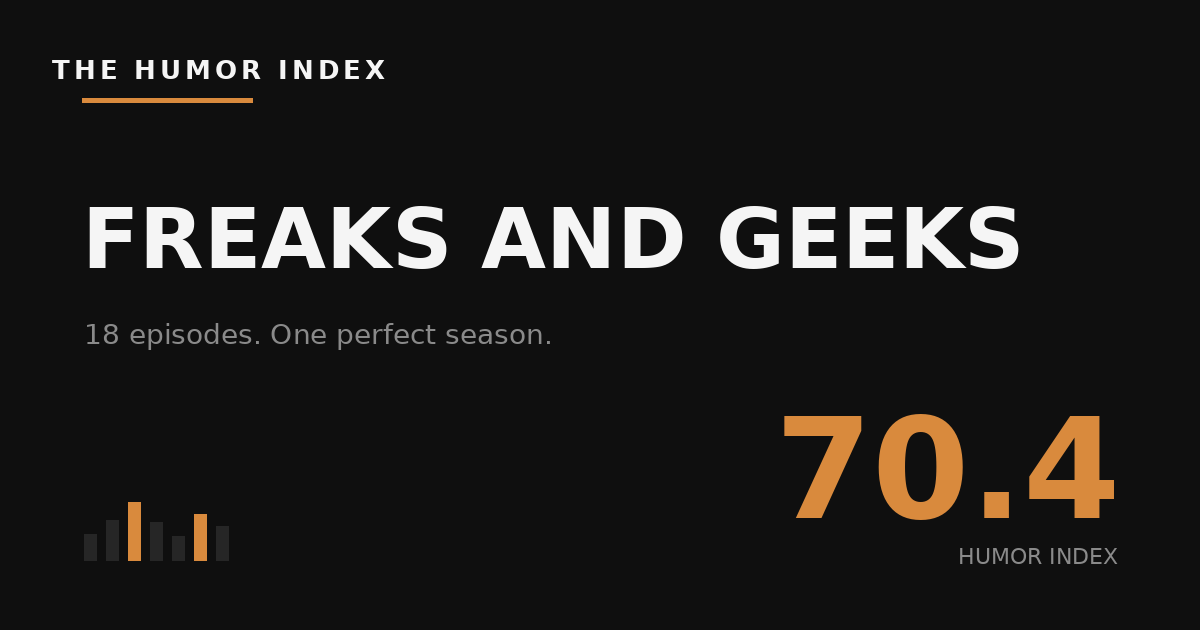
Freaks and Geeks lasted 18 episodes. One season, canceled in 2000, beloved forever. We ran every one of those episodes through the Humor Index — 1,231 jokes — and the show landed a 70.4, one of the lowest scores on our entire leaderboard.
If you love this show, that number probably feels wrong. It isn't. It's just measuring something Freaks and Geeks was never trying to win.
The Humor Index rewards joke machines. This isn't one.
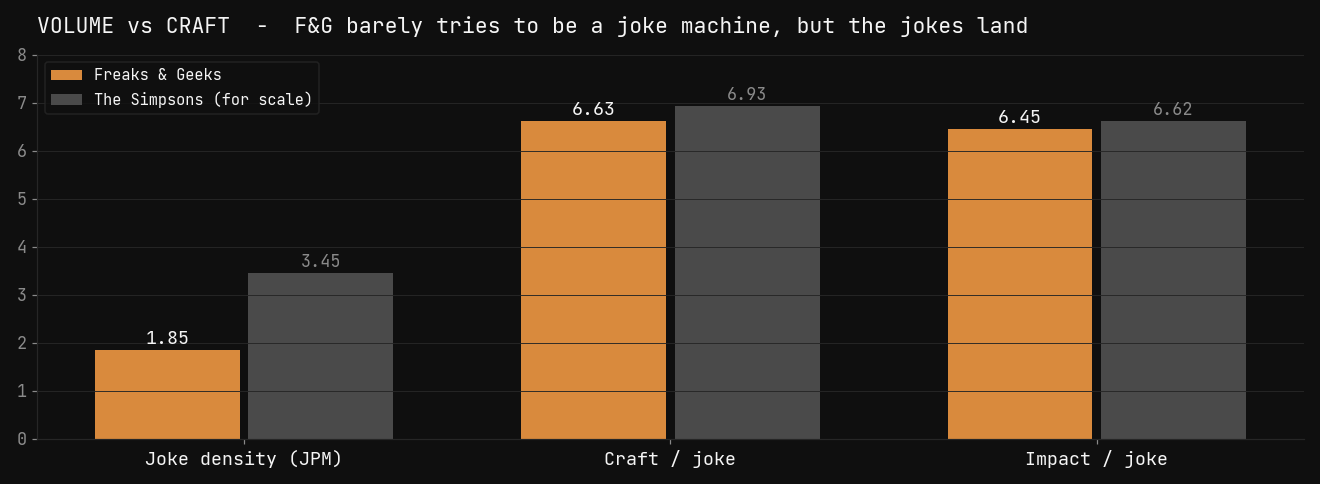
The Humor Index is built from three things: how often a show goes for a joke, how well-crafted those jokes are, and how hard they land. Most great comedies are dense — they fire a punchline every fifteen or twenty seconds.
Freaks and Geeks fires one roughly every thirty-two seconds. Its joke density — 1.85 jokes per minute — is among the lowest of any show we've scored, less than half the rate of a vintage Simpsons episode. This is a show that will happily let a scene breathe for a full minute of awkward silence in a high-school hallway because the silence is the point.
So it gives up a lot of ground on volume. What it keeps is everything else: a craft-per-joke of 6.63 and an impact-per-joke of 6.45, both well above the league floor. When Paul Feig and Judd Apatow's writers decided to go for it, they connected. They just didn't go for it very often — and the index, which counts swings as well as hits, marks them down for the restraint.
That's the whole paradox in one line: the lowest-volume show on the board is also one of the highest-quality, and the metric can only see one of those things at a time.
The strangest stat: its funniest moments are its saddest.
Here's what really separates Freaks and Geeks from everything else we've scored.
Pull up the highest-rated "jokes" in the series and almost none of them are jokes. The single best-scoring beat in all 18 episodes is Daniel's confession about being labeled "Track 3 — the dumb kids" at age eleven (craft 8.8, impact 9.0). Right behind it: Lindsay's grandmother on her deathbed admitting there's nothing waiting on the other side — "No. There's nothing." (craft 8.6, impact 9.0).
These are gut-punches. Our model rated them as the show's comic high points because in Freaks and Geeks the line between the funniest moment and the most devastating one barely exists. The humor and the heartbreak are the same scene. No other show on the leaderboard does this.
When it does play things straight-funny, it's lethally dry:
- Ken: "I had my appendix out, so, you know, I've been there." (craft 8.4, impact 8.8) — the best deadpan in the series.
- Bill: "What are you gonna do, call my mom?" (craft 8.4) — the geek who accidentally lands the most awkward threat possible on the gym teacher dating his mother.
- Bill again: "Sam, our bodies are merely a shell which conceal our heavenly souls. Try not to get too uptight. Auf wiedersehen."
Who actually carries it
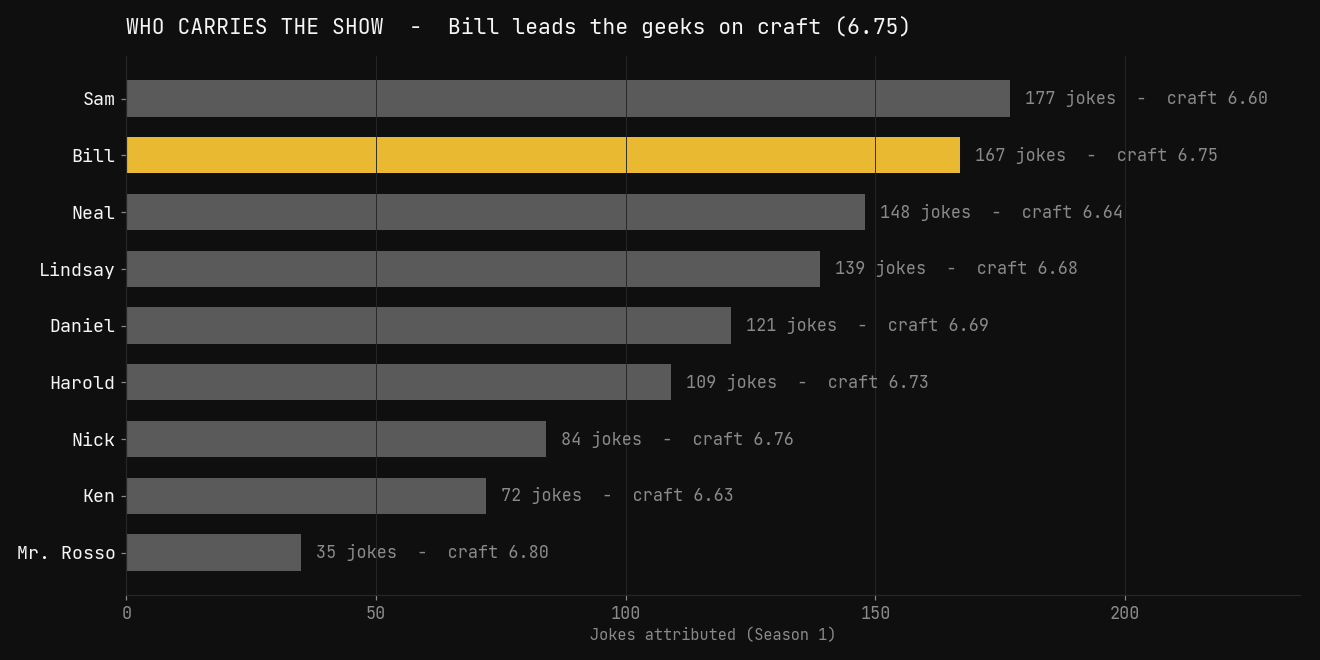
By raw volume, Sam narrowly leads the show with 177 attributed jokes. But the craft MVP of the geek trio is Bill — 167 jokes at a 6.75 craft rating, the highest of the three, which tracks with him becoming the show's breakout cult favorite.
The quieter story is in the supporting ranks. The two characters who punch hardest per line aren't kids at all — Mr. Rosso, the well-meaning guidance counselor (craft 6.80), and Harold Weir, the doom-saying dad (craft 6.73), land the heaviest hits in the cast. In a show about teenagers, the adults get some of the best material.
The verdict
A 70.4 makes Freaks and Geeks look like a weak comedy. It's the opposite. It's the show our index is worst at measuring — and that's the compliment. The Humor Index is excellent at finding the joke machines. Freaks and Geeks was never a machine. It was 18 episodes that valued one true, mortifying, perfect moment over a hundred easy laughs, and the math simply can't reward that.
Some shows you score. This one you just rewatch.